
Baltimore Metro
Metro Area Overview
Market Trend Map
Metro Area Overview
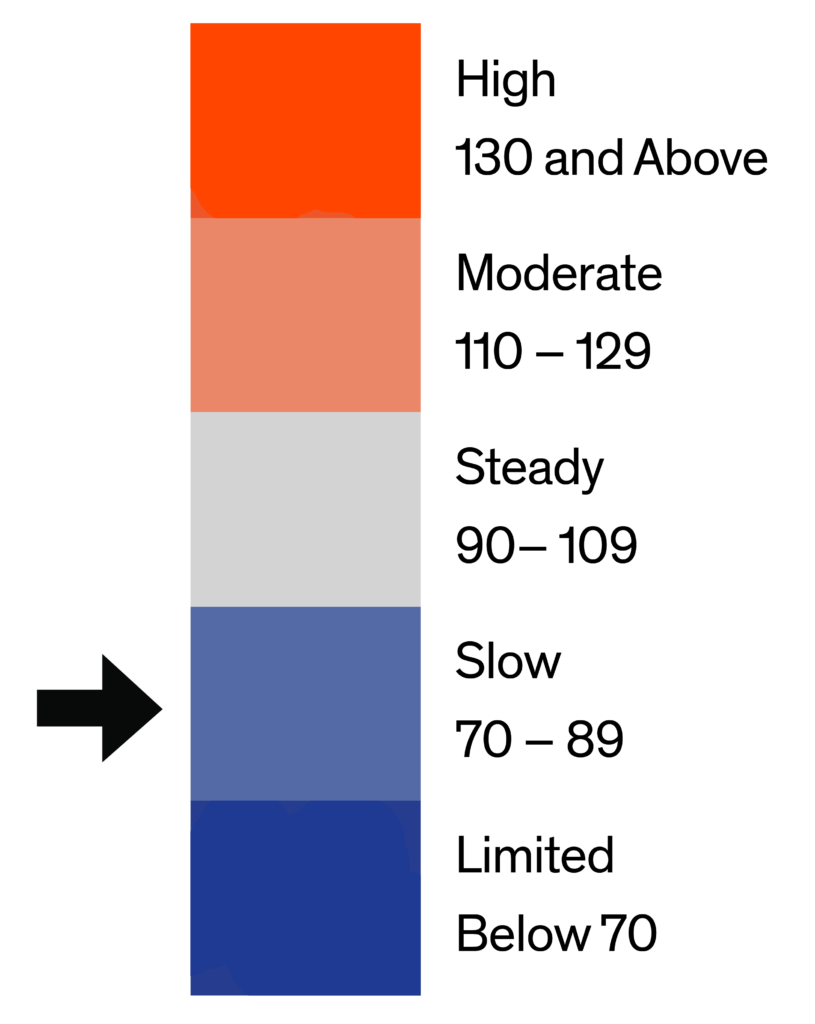
The Home Demand Index (HDI) for the Baltimore metro area stands at 81 for this report period, down 4 points from last month’s 85 and below the 91 recorded one year ago. That leaves the market 4.7% lower on the month and 11.0% lower than a year ago, extending the late-summer cooling and keeping a Slow demand rating as the fall season begins. The softening is broad: five of the six home-type tiers eased on the month, with only the small luxury condo segment edging higher, which points to affordability pressure rather than a localized shift.
The market trend line, below, provides a high-level monthly overview of the Home Demand Index for each of the metro market areas within the Greater Baltimore Metro Area. The Home Demand Index is baselined at 100, with 90-110 indicating a steady market. Index values above 110 indicate moderate and high activity while Index values below 90 indicate slower or limited activity. For more information for a given period of time, click on any point on the map to pull up the monthly report.

Metro Market Trend Data by Bright MLS | T3 Home Demand Index
Each of the market areas listed above are defined as follows:
- Baltimore Metro – Anne Arundel, MD; Baltimore City, MD; Baltimore, MD; Carroll, MD; Harford, MD; Howard, MD;
- DelMar Coastal – Somerset, MD; Sussex, DE; Wicomico, MD; Worcester, MD;
- Maryland Eastern Shore – Caroline, MD; Cecil, MD; Dorchester, MD; Kent, MD; Queen Annes, MD; Talbot, MD;
Market Trend Map
The Market Trend Map for the Baltimore Metro pulls the county map from the monthly reports and combines to provide a time-lapse of the overall market. Use the navigation at the bottom to toggle between months.

Baltimore Metro County-Level Market Trend Map | Home Demand Index
Current Market Report
Last 6 Market Reports
Historical Market Reports
Data Download
Baltimore | October 2026
Home Demand Index
The Home Demand Index (HDI) for the Baltimore metro area stands at 81 for this report period, down 4 points from last month’s 85 and below the 91 recorded one year ago. That leaves the market 4.7% lower on the month and 11.0% lower than a year ago, extending the late-summer cooling and keeping a Slow demand rating as the fall season begins. The softening is broad: five of the six home-type tiers eased on the month, with only the small luxury condo segment edging higher, which points to affordability pressure rather than a localized shift.
Demand by home type in Baltimore this period ranges from a high of 121 in the luxury condo tier to a low of 68 in the entry single-family tier. The condo tiers continue to screen strongest, with entry condos at 108 (Steady) and luxury condos at 121 (Moderate), the only segment to gain on the month. Single-family demand sits lower and softened across all three price bands: entry at 68 (Limited), mid-range at 78 and luxury at 84, the latter down 22 points from a year ago. The townhouse/rowhouse format reads 86, down 6 points on the month. Inventory runs from about 2.8 months in mid-range single-family to 5.3 months in luxury condos, leaving the metro balanced-to-soft rather than tight.
Monthly Statistics for October 2026
Home Demand
Index
Index
81
(Slow)
Home Demand Index
from prior month
from prior month
85
Home Demand Index
from prior year
from prior year
91
Index change
from prior month
from prior month
-4.7%
Index change from
same time last year
same time last year
-11.0%
Bright MLS | T3 Home Demand Index
www.homedemandindex.com
Baltimore | September 2026
Home Demand Index
The Home Demand Index (HDI) for the Baltimore metro area stands at 83 for this report period, down 6 points from last month’s 89 and below the 90 recorded one year ago. That leaves the market 6.7% lower on the month and 7.8% lower than a year ago, a broad-based cooling that carries a Slow demand rating heading into the fall. The pullback is consistent across most home-type and price tiers rather than concentrated in any single segment, pointing to rate-and-affordability fatigue rather than a localized shift.
Demand by home type in Baltimore this period ranges from a high of 117 in the luxury condo tier to a low of 67 in the entry single-family tier, with most segments softening month over month. The condo tiers continue to screen strongest on the index, while single-family demand sits lower, a pattern driven by the affordability advantage condos hold at their price points. Entry single-family remains the most payment-sensitive tier at 67 (Limited), and mid-range single-family sits at 81. Luxury single-family reads 87 and the townhouse/rowhouse format 89, both easing on the month. Inventory generally sits in the two-to-five-month range across tiers, keeping the metro balanced-to-soft rather than tight.
Monthly Statistics for September 2026
Home Demand
Index
Index
83
(Slow)
Home Demand Index
from prior month
from prior month
89
Home Demand Index
from prior year
from prior year
90
Index change
from prior month
from prior month
-6.7%
Index change from
same time last year
same time last year
-7.8%
Bright MLS | T3 Home Demand Index
www.homedemandindex.com
Baltimore | August 2026
Home Demand Index
The Home Demand Index (HDI) for the Baltimore metro area stands at 87 for this report period, flat with last month’s 87 and below the 93 recorded during the same period one year ago. The absence of month-over-month movement follows two consecutive months at an identical reading, indicating the metro has settled into a stable plateau rather than continuing the sharper swings that characterized the spring cycle, consistent with the seasonal deceleration that typically sets in as the peak-selling window narrows heading into late summer. The most significant development within the tier structure is the fifty-five-point year-over-year decline in luxury condo demand, the widest single-tier annual gap recorded in this report, which should be read against an unusually strong luxury condo market in August 2025 rather than as evidence of acute current-period weakness in this thin, low-volume segment.
Demand by home type in Baltimore this period shows four of six tiers in Steady territory, with mid single-family remaining in Slow territory and entry single-family remaining in Limited range as the metro’s persistent affordability constraint. Entry single-family rose two points to 68, continuing to reflect the most acute payment-affordability pressure at the sub-$375,000 detached price point, while mid single-family was similarly flat at 85 and remained in Slow territory. Luxury single-family eased six points to 104, remaining comfortably in Steady territory as buyers at these price points remain more insulated from financing-cost sensitivity. Entry condo eased five points to 109 and luxury condo gave back nineteen points to 106, both remaining in Steady territory, though luxury condo’s fifty-five-point year-over-year shortfall is the widest single-tier annual gap in this report and should be read against an unusually strong luxury condo market a year ago rather than current weakness. Townhouse gained one point to 92, remaining in Steady territory and a reasonable proxy for the broader market’s underlying health this period.
Monthly Statistics for August 2026
Home Demand
Index
Index
87
(Slow)
Home Demand Index
from prior month
from prior month
87
Home Demand Index
from prior year
from prior year
93
Index change
from prior month
from prior month
0.0%
Index change from
same time last year
same time last year
-6.5%
Bright MLS | T3 Home Demand Index
www.homedemandindex.com
Baltimore | July 2026
Home Demand Index
The Home Demand Index (HDI) for the Baltimore metro area stands at 84 for this report period, up four points from 80 last month and below the 96 recorded during the same period one year ago. The four-point month-over-month gain is a counter-seasonal result, July typically marks a deceleration from the June peak as the active selling window narrows, and suggests that a cohort of buyers motivated by the brief rate-dip window that opened during May and June closed transactions into early July, extending the demand signal one period beyond the seasonal ceiling that most years arrives in June. The twelve-point year-over-year deficit, while meaningful, should be read against the unusually strong July 2025 baseline, when the Baltimore metro was completing an extended spring cycle that had been supported by regional employment stability and a temporary easing in rate-lock psychology; the absolute level of 84 reflects a functioning Slow-territory summer market rather than a structural deterioration in demand fundamentals. The widening spread between the condo tiers, which are running at Steady and Moderate levels, and the entry single-family tier, which remains in Limited territory at 62, continues to define the most important cross-segment dynamic in this market, as buyers facing persistent affordability friction at the lowest detached price points migrate into the attached inventory that offers more accessible entry thresholds in a market where financing sensitivity remains the primary demand governor.
Demand by home type in Baltimore shows a divergent pattern this period that stands in contrast to the broad-based softening observed in the previous period, with the metro-wide counter-seasonal recovery to 84 driven primarily by strength in the attached and upper-tier segments while the entry single-family floor remains constrained. The most notable development across the tier structure is the surge in entry condo demand to 110, a twenty-point month-over-month gain from the previous reading of 90 that represents the largest single-tier sequential move in the current reporting cycle and has pushed this segment into Steady territory for the first time in recent periods. Luxury condos at 124, a ten-point gain from 114 last month, reinforced this signal with a Moderate-range reading that is the highest absolute index across any tier in the metro. Luxury single-family homes at 108 declined three points from 111 last month but remain in Steady territory, while mid single-family held flat at 81 and entry single-family ticked up one point to 62, the latter remaining in Limited territory and continuing to reflect the most acute affordability compression in the metro at the sub-$375,000 detached price point. The townhouse, rowhouse, and twin home segment gained seven points to 87, a Slow-territory reading consistent with the metro average and suggesting that the attached single-family category is contributing meaningfully to the counter-seasonal demand signal alongside the condo tiers. The emerging divergence between a strong attached market and a constrained entry SF market is the defining structural dynamic in Baltimore’s current demand picture.
Monthly Statistics for July 2026
Home Demand
Index
Index
84
(Slow)
Home Demand Index
from prior month
from prior month
80
Home Demand Index
from prior year
from prior year
96
Index change
from prior month
from prior month
5.0%
Index change from
same time last year
same time last year
-12.5%
Bright MLS | T3 Home Demand Index
www.homedemandindex.com
Baltimore | June 2026
Home Demand Index
The Home Demand Index (HDI) for the Baltimore metro area stands at 77 for this report period, down from 93 last month and below the 99 recorded during the same period one year ago. The sixteen-point month-over-month decline marks a pronounced reversal from the spring reactivation that had been building since February, signaling that peak-season demand has rolled over more sharply than seasonal norms would suggest and raising the possibility that affordability constraints and financing sensitivity are reasserting pressure as buyer urgency fades entering the early summer period. The twenty-two-point year-over-year deficit represents the widest annual gap recorded in recent reporting cycles for this metro, indicating that the Baltimore market is now tracking at a measurably softer level than the same period last year, with the structural headwinds of elevated home prices and persistent rate sensitivity continuing to erode the demand base that briefly appeared to be consolidating through the spring.
Demand by home type in Baltimore shows broad-based softening this period, consistent with the metro-wide index declining to 77 from 93 last month, with all segments likely registering meaningful month-over-month retreats as the post-spring demand rollover takes hold across the buyer spectrum. Entry-level single-family homes remain the most constrained tier, with first-time and value-driven buyers continuing to face acute affordability barriers at the lowest price points in a market where financing sensitivity is most pronounced, and the pullback in overall engagement is likely deepest in this segment given the lowest index reading. Mid-range single-family demand is retreating from spring highs as move-up buyer urgency fades, consistent with the market transitioning from the peak-urgency phase of the selling season toward a more measured early-summer pace. Luxury single-family activity, while retreating from its strong May reading, is likely exhibiting greater relative resilience than lower tiers, as discretionary buyers with less financing dependency maintain selective engagement with premium inventory. Entry-level condos continue to meaningfully outperform entry-level and mid-range single-family categories on an absolute basis, maintaining their structural role as the primary affordability outlet in the metro, though they remain below luxury single-family levels. Luxury condos and townhouses, rowhouses, and twin homes are moderating from their spring peaks in line with the broader market, with luxury condos retaining above-metro-average readings, while townhouses, rowhouses, and twin homes are now broadly in line with the metro average.
Monthly Statistics for June 2026
Home Demand
Index
Index
77
(Slow)
Home Demand Index
from prior month
from prior month
93
Home Demand Index
from prior year
from prior year
99
Index change
from prior month
from prior month
-17.2%
Index change from
same time last year
same time last year
-22.2%
Bright MLS | T3 Home Demand Index
www.homedemandindex.com
Baltimore | May 2026
Home Demand Index
The Home Demand Index (HDI) for the Baltimore metro area stands at 89 for this report period, unchanged from 89 last month and below the 98 recorded during the same period one year ago. The flat month-over-month reading signals that the spring reactivation has plateaued rather than continued to build momentum into peak selling season, marking a notable shift from the sequential gains that characterized the recovery through March and April. The nine-point year-over-year deficit indicates the Baltimore market has not yet closed the gap with the prior-year level, with affordability constraints and financing sensitivity continuing to temper buyer engagement even as the market operates near its seasonal peak.
Entry-level single-family activity remains the most constrained tier, with first-time buyers continuing to navigate persistent affordability barriers at the lowest price points in a market where financing sensitivity is most acute, while mid-range single-family homes are tracking at 88, up from 83 last month, as move-up activity sustains without further spring acceleration. Luxury single-family demand remains selective but has rebounded sharply to 115 from 89, reflecting measured engagement consistent with the discretionary nature of this tier and the year-over-year shortfall observed throughout the spring cycle. Entry-level condos continue to outperform detached categories on an absolute basis, consistent with their role as the primary affordability alternative in the metro, while luxury condos, which declined to 135 from 154 last month, may be moderating from elevated readings as the season matures and initial demand absorbs available premium inventory. Townhouses and rowhouses are tracking near 91, down from 97 previously, sustained by their appeal among buyers seeking space-to-price efficiency in a market where detached single-family affordability remains structurally strained.
Monthly Statistics for May 2026
Home Demand
Index
Index
89
(Slow)
Home Demand Index
from prior month
from prior month
89
Home Demand Index
from prior year
from prior year
98
Index change
from prior month
from prior month
0.0%
Index change from
same time last year
same time last year
-9.2%
Bright MLS | T3 Home Demand Index
www.homedemandindex.com
Baltimore | April 2026
Home Demand Index
The Home Demand Index (HDI) for the Baltimore metro area stands at 86 for this report period, up notably from 76 last month but below the 93 recorded during the same period one year ago. This meaningful month-over-month acceleration signals a decisive spring reactivation in buyer engagement, consistent with Baltimore’s historical pattern of demand strengthening through April as seasonal inventory and buyer urgency converge. Despite the annual shortfall, the rebound suggests improving momentum, indicating that the affordability and rate headwinds that suppressed activity through the winter are beginning to ease as conditions stabilize.
Demand by home type in Baltimore shows broad-based improvement this period, with most segments posting meaningful month-over-month gains as spring buyer activity accelerates, though all segments remain below year-ago levels. Entry-level single-family homes registered an index of 71, up from 69 last month and below the 76 posted one year ago, reflecting improving first-time buyer engagement though affordability constraints continue to cap the pace of recovery in this rate-sensitive tier. Mid-range single-family homes advanced to 80 from 67 last month, but remain below last year’s reading of 88, suggesting move-up buyer activity is building meaningful spring momentum after a subdued winter. Luxury single-family homes climbed to 84 from 70 last month, but remain below last year’s 104, pointing to selective but expanding high-end engagement as spring inventory enters the market. Entry-level condos rose to 116 from 110 last month, but remain below last year’s 136, reinforcing their position as the most consistently active demand tier in the metro and a primary affordability alternative for buyers navigating constrained detached home budgets. Luxury condos advanced to 149 from 114 last month, though still trailing last year’s 160, as the high-end attached segment continues to normalize following an elevated prior-spring period that may have pulled forward activity. Townhouses, rowhouses, and twin homes rose strongly to 94 from 85 last month, slightly below last year’s 98, signaling that this segment is nearing prior-spring demand levels and is benefiting robustly from spring buyer reactivation.
Monthly Statistics for April 2026
Home Demand
Index
Index
86
(Slow)
Home Demand Index
from prior month
from prior month
76
Home Demand Index
from prior year
from prior year
93
Index change
from prior month
from prior month
13.2%
Index change from
same time last year
same time last year
-7.5%
Bright MLS | T3 Home Demand Index
www.homedemandindex.com
All reports for the Baltimore Market Area.
List of available data files. Note that the data file includes all data for the report period across the entire Bright MLS footprint.