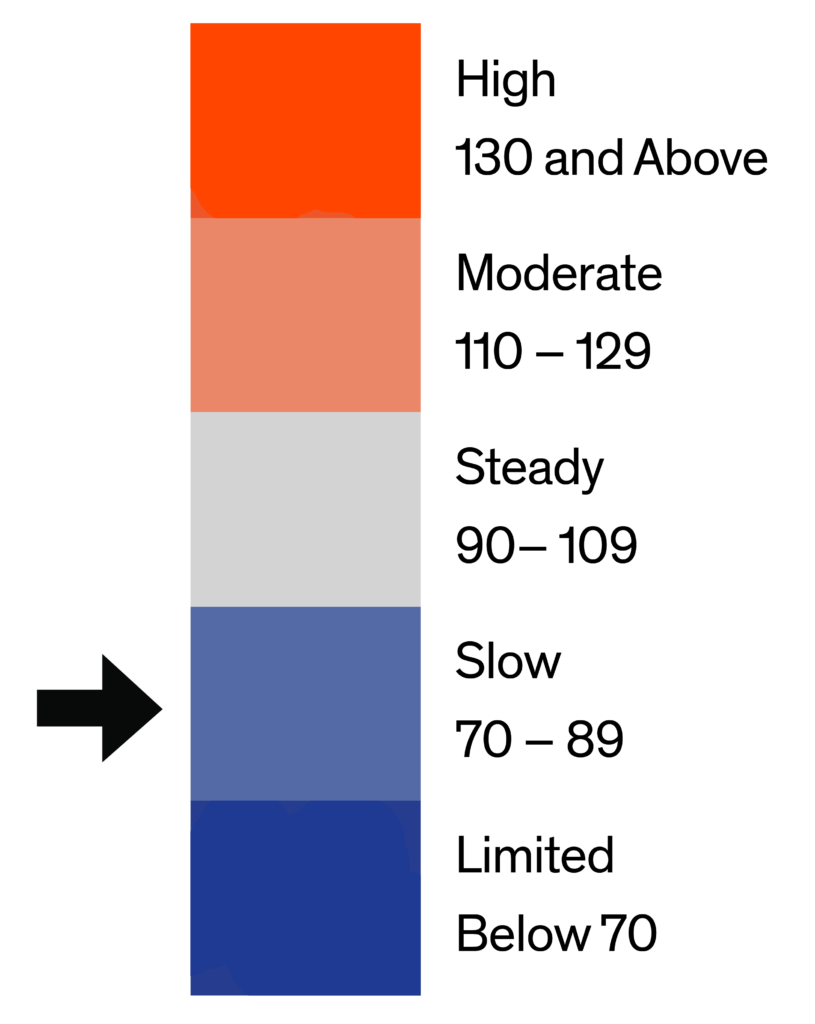
What is the Home Demand Index?

The Home Demand Index (HDI) is the nation’s only local housing market index that tracks pre-sale activity to measure housing market competitiveness. The HDI uses data on pre-sale activities, including in-person showings of homes and views of homes online, to measure housing market activity across different geographies and types of homes. The data used to construct the HDI are the most accurate and up-to-date information from the real estate agents and prospective buyers and sellers that are active in the market.

While most housing market indices are based on history, the HDI provides forward-looking insights to real estate professionals and consumers to help make better decisions in a rapidly changing real estate market

Embed this tile on your site (links update monthly).

Greater Metropolitan Market Areas

The Bright MLS |T3 Home Demand Index currently covers the three greater metropolitan market areas served by Bright MLS, namely the Greater Philadelphia Area (in blue), the Greater Washington D.C. Area (in gray), and the Greater Baltimore Area (in orange). Colors are provided for visual identification of each market area and do not correlate to index activity level. Make a selection on the map to go to the report for a market area or view an overview of each market area here..
Bright MLS | T3 Home Demand Index

www.homedemandindex.com

Washington D.C. | May 2026

Home Demand Index

The Home Demand Index (HDI) for the Washington DC metro area stands at 98 for this report period, up from 95 last month but slightly below the 102 recorded during the same period one year ago. The three-point month-over-month increase reflects a modest uptick in buyer activity as the market continues to transition into the spring season. This gradual improvement indicates steady engagement rather than a sharp surge in demand. However, the four-point year-over-year gap suggests that activity remains just below last year’s pace. Overall, with demand holding within the Steady category, the market reflects stable conditions, with consistent buyer interest supporting a balanced and measured pace of activity as the season progresses.
Demand by home type in the Washington DC metro reflects mixed performance this period, with overall conditions showing uneven strength across price segments. Entry-level single-family homes stand at 85, indicating stable but constrained activity consistent with affordability pressures in the lower-tier market. Mid-range single-family homes rise to 90, reflecting improving momentum in the move-up segment and signaling one of the stronger areas of demand within the single-family category. Luxury single-family homes register 133, showing the most pronounced strength among single-family tiers and pointing to continued interest in higher-end properties despite broader market sensitivity. Entry-level condos stand at 115, reflecting moderated activity while still serving as a key affordability channel in the metro. Luxury condos at 125 show firmer engagement at the upper end of the condominium market, though demand remains uneven across segments. Townhouses and twin homes at 98 indicate broadly stable conditions with modest softness relative to other property types, highlighting a more measured pace in this middle-housing category.
Monthly Statistics for May 2026
Home Demand
Index
98
(Steady)
Home Demand Index
from prior month
95
Home Demand Index
from prior year
102
Index change
from prior month
3.2%
Index change from
same time last year
-3.9%
Bright MLS | T3 Home Demand Index

www.homedemandindex.com

Philadelphia | May 2026

Home Demand Index

The Home Demand Index (HDI) for the Philadelphia metro area stands at 87 for this report period, up from 82 last month and below the 92 recorded during the same period one year ago. The five-point month-over-month gain reflects continued spring reactivation in buyer engagement, extending the recovery trajectory established since the prior dip and positioning the market in a stronger month-to-month recovery phase. The five-point year-over-year shortfall indicates the Philadelphia metro has not yet fully aligned with last May’s demand level, with affordability constraints and financing sensitivity continuing to moderate the pace of recovery even as seasonal patterns provide meaningful near-term support.
Demand by home type in Philadelphia shows a mixed but generally improving picture this period, with overall activity rising to an index of 87, up from 82 last month but still below 92 one year ago. Entry-level single-family homes held steady at 78, unchanged month-over-month and below 86 year ago, reflecting continued affordability constraints. Mid-range single-family homes improved to 80 from 70 last month but remain slightly below 82 year ago, while higher-end single-family homes also recorded 80, rising sharply from 62 last month but still below 88 year ago, signaling a strong rebound from last month’s low base. Entry-level condos remained stable at 117, unchanged month-over-month and slightly below 119 year ago, continuing to represent the strongest demand segment, while higher-end condos eased to 118 from 129 last month and are below 126 year ago, reflecting normalization after a stronger prior period. Townhomes and twin homes registered 93, down slightly from 94 last month and below 102 year ago, indicating mild softening in attached housing demand while remaining relatively balanced overall.
Monthly Statistics for May 2026
Home Demand
Index
87
(Slow)
Home Demand Index
from prior month
82
Home Demand Index
from prior year
92
Index change
from prior month
6.1%
Index change from
same time last year
-5.4%
Bright MLS | T3 Home Demand Index

www.homedemandindex.com

Baltimore | May 2026

Home Demand Index

The Home Demand Index (HDI) for the Baltimore metro area stands at 89 for this report period, unchanged from 89 last month and below the 98 recorded during the same period one year ago. The flat month-over-month reading signals that the spring reactivation has plateaued rather than continued to build momentum into peak selling season, marking a notable shift from the sequential gains that characterized the recovery through March and April. The nine-point year-over-year deficit indicates the Baltimore market has not yet closed the gap with the prior-year level, with affordability constraints and financing sensitivity continuing to temper buyer engagement even as the market operates near its seasonal peak.
Entry-level single-family activity remains the most constrained tier, with first-time buyers continuing to navigate persistent affordability barriers at the lowest price points in a market where financing sensitivity is most acute, while mid-range single-family homes are tracking at 88, up from 83 last month, as move-up activity sustains without further spring acceleration. Luxury single-family demand remains selective but has rebounded sharply to 115 from 89, reflecting measured engagement consistent with the discretionary nature of this tier and the year-over-year shortfall observed throughout the spring cycle. Entry-level condos continue to outperform detached categories on an absolute basis, consistent with their role as the primary affordability alternative in the metro, while luxury condos, which declined to 135 from 154 last month, may be moderating from elevated readings as the season matures and initial demand absorbs available premium inventory. Townhouses and rowhouses are tracking near 91, down from 97 previously, sustained by their appeal among buyers seeking space-to-price efficiency in a market where detached single-family affordability remains structurally strained.
Monthly Statistics for May 2026
Home Demand
Index
89
(Slow)
Home Demand Index
from prior month
89
Home Demand Index
from prior year
98
Index change
from prior month
0.0%
Index change from
same time last year
-9.2%
Bright MLS | T3 Home Demand Index

www.homedemandindex.com